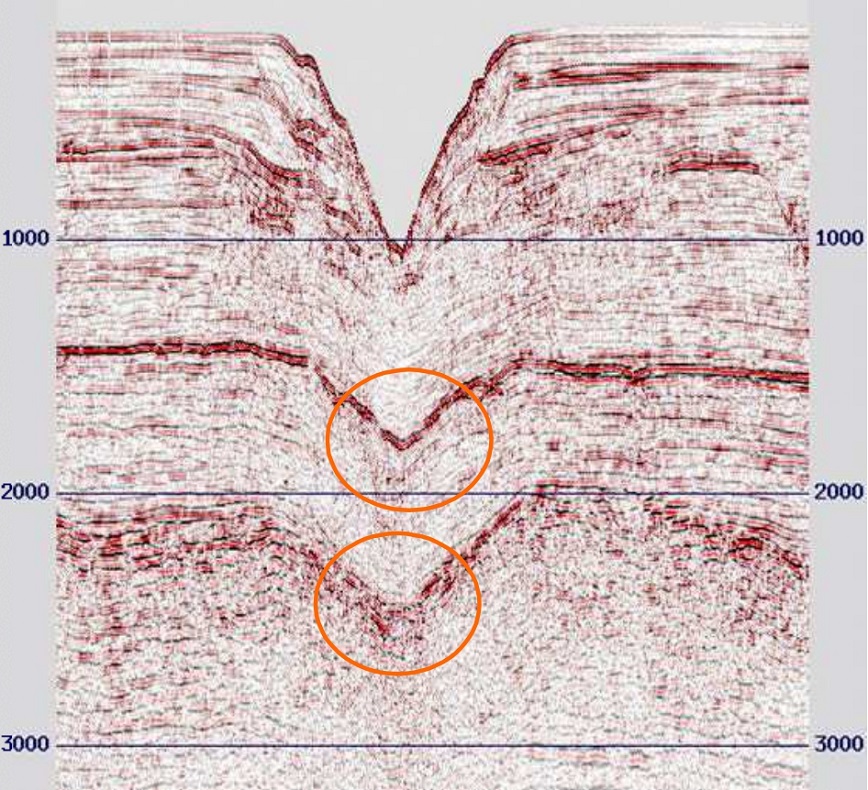
Pre-stack Depth Migration Complete solution. Modelled channel and near surface velocities successfully correct for the ray-path bending at the sea-floor, as well as the bright limestone event (approx 1500ms) Channel shape is unchanged in all cases – but the velocity variation is correctly modelled.
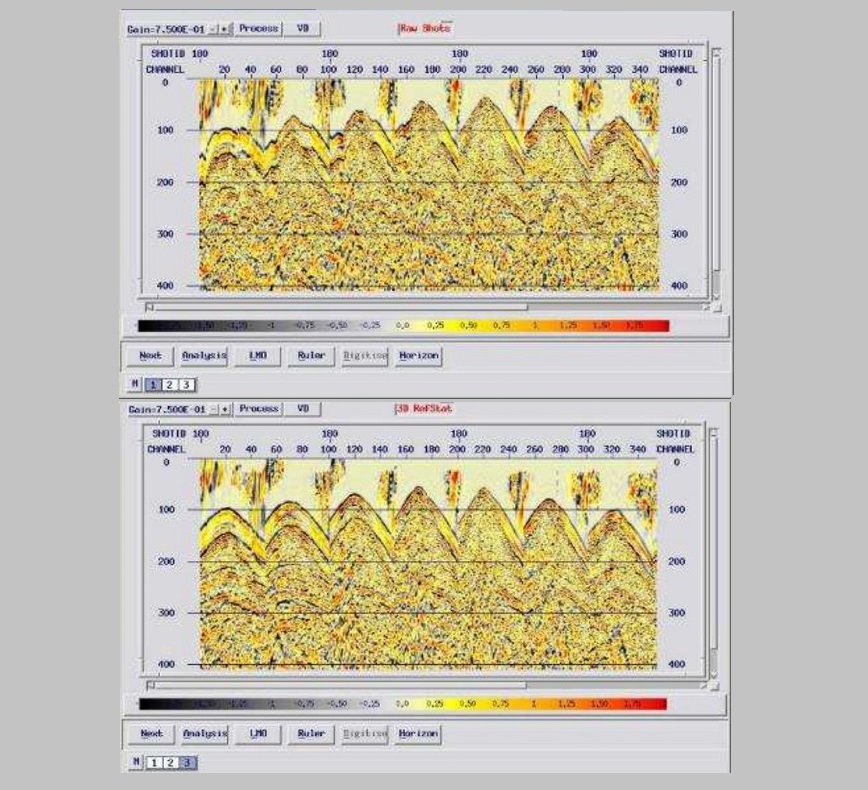
<p><p>The RefStat approach is equally effective on 3D data or where the issue is low near surface velocity anomalies of varying thickness</p></p>
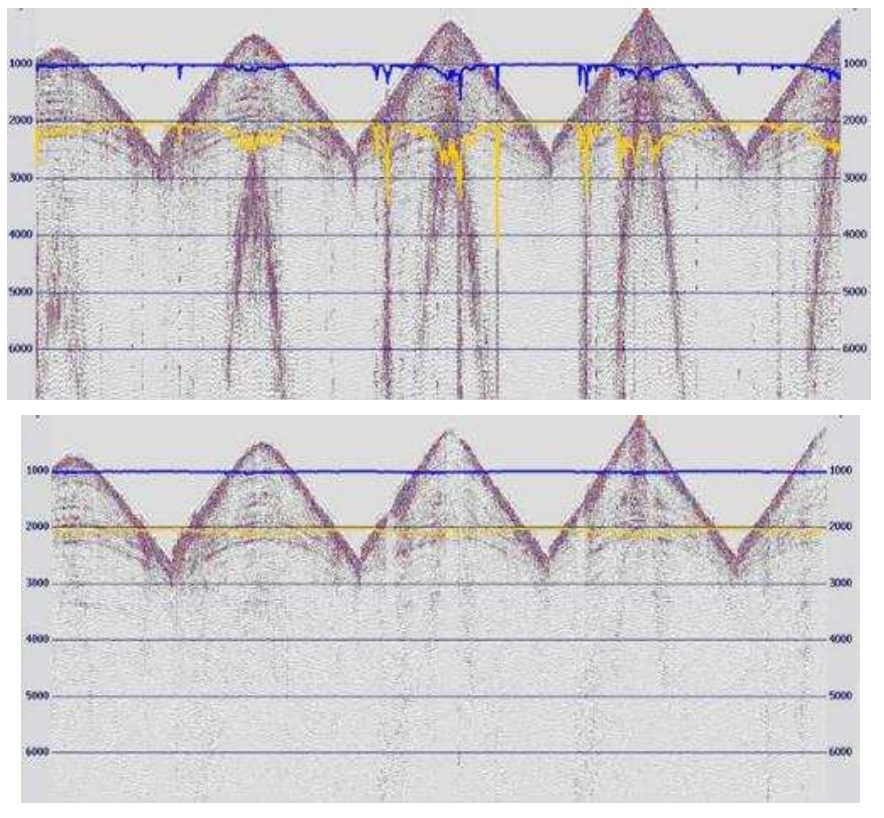
Interactive analysis tools and the ability to spatially vary workflows allows users to rapidly optimise the quality of pre-stack land or marine seismic data. In this case, RMS (blue) and peak (yellow) amplitudes are used to guide land noise attenuation approaches on 3D datasets
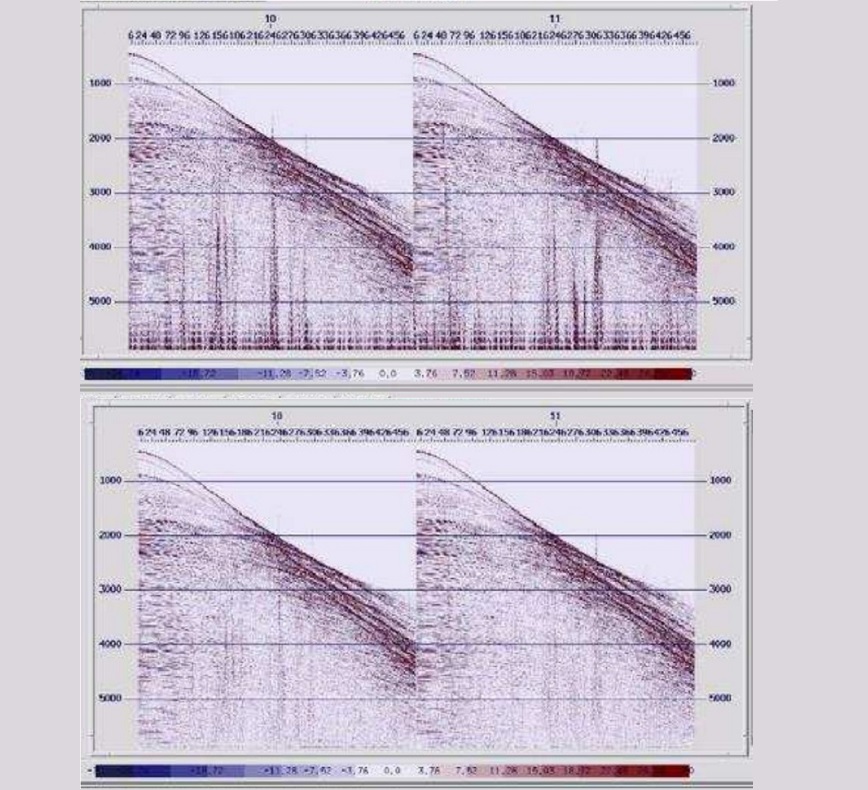
DUSWELL removes swell-noise trains from the data without compromising the overall frequency content. Like most modules, it can be run in parallel on any number of cores/CPUs.
Interpolation Results : Example of interpolating a shot record from 24 fold to 96 fold using the OFFREG spatial resampling processor. Original group interval (100m) has been interpolated to 25m. FK plots (below) illustrate the extent to which this has unwrapped the steep-dip spatial aliasing issues caused by the course group interval. Original data was acquired in 1974.